01 · Case study · Product Design · UX/UI · Environmental Comfort
Room Cool
Why a bedroom can feel unevenly cooled even when an AC is running.
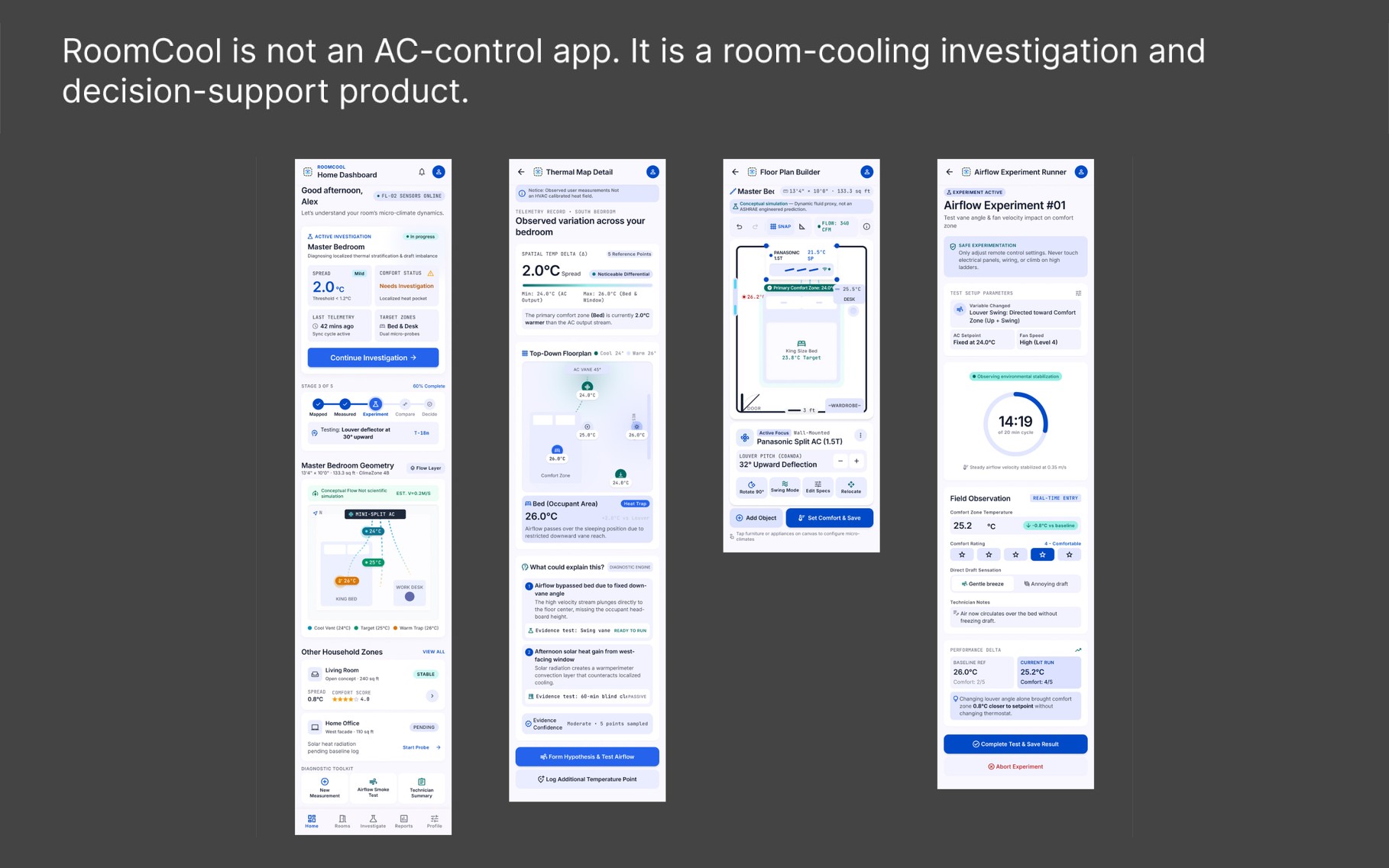
Room Cool is a room-cooling investigation and decision-support experience — not an AC remote-control app. It helps people understand uneven indoor temperatures, explore possible causes, test airflow adjustments, and compare comfort observations. I explored why a bedroom can feel unevenly cooled even when an AC is running: instead of assuming the appliance was faulty, I looked at how airflow, room layout, windows, furniture, settings, and daily usage could affect comfort. I structured the investigation around research questions, safe experiments, and measurable outcomes, with a focus on understanding the problem before recommending a solution. The next step is to validate the findings through controlled testing.
- Role
- Product design research — framing, research questions, journey, experiment protocol and success measures
- Duration
- One day
- Project type
- One-day design research and product concept
- Users
- Primary: the bedroom occupant, who needs stable comfort where time is actually spent. Secondary: other household members with different airflow and temperature preferences. Expert stakeholder: a qualified HVAC technician, consulted only when evidence justifies it.
- Status
- Validation pending
Outcome summary
A structured, safe investigation plan rather than a repair: no placement decision is made yet. Evidence is insufficient and requires controlled testing.
02
Problem context
In a 13′4″ × 10′ × 10′ bedroom (≈133 sq ft) cooled by a 1.5-ton inverter split AC, five supplied readings ranged from 24°C near the AC and floor to 26°C at the window and bed/sofa — a 2°C spread. The easy assumption is that the AC is defective.
03
Research insight
Journey to map. Enter → Set → Cool → Occupy → Sleep / dwell → Review. Mapping the full use cycle stops a brief cold blast from being mistaken for sustained comfort.
04
History
Reframe before repair. Instead of “uneven cooling means the AC is defective”, the question became: what combination of airflow, heat gain, room geometry, furniture, windows, occupancy, settings and installation could explain the experience?
- — Placement
- — Airflow direction
- — Room geometry
- — Furniture
- — Windows
- — Heat gain
- — Occupied zones
- — Settings
- — Installation
05
Geography
Comfort is spatial. A room can reach its target temperature while the person in it still feels too warm, too cold or exposed to a draft. Thermal comfort also depends on air speed, radiant temperature, humidity, clothing and activity.
- — Window / wall: 26°C
- — AC zone: 24°C
- — Room centre: 25°C
- — Bed / sofa: 26°C
- — Floor: 24°C
- — Position, height, time and instrument not yet documented
06
Physics — how the product behaves
Journey to map. Enter → Set → Cool → Occupy → Sleep / dwell → Review. Mapping the full use cycle stops a brief cold blast from being mistaken for sustained comfort.
07
Chemistry — the emotional layer
Research questions. Discomfort was turned into five inquiries.
- — Where is comfort needed, and where are readings taken?
- — Does the pattern change with time of day, sunlight, occupancy or time since switch-on?
- — Do furniture, curtains, doors or vane direction redirect air?
- — Which walls, windows, people, lights or devices add heat?
- — Can settings, shading or circulation reduce the spread before considering relocation?
08
Biology — repeated behaviour
Opportunity areas to validate. Each is a hypothesis to test, not a solution.
- — Air path — vane angle, fan speed, safe circulation (low effort)
- — Heat boundary — window shading at matched times (low effort)
- — Spatial blockers — furniture or fabric in the air path (observe first)
- — Control context — settings, doors and occupancy held constant (required)
- — Placement — another position, only after technician review
- — System condition — expert check only if controlled trials stay uneven
09
Mathematics — evidence
Observed spread (supplied readings)
2°C (24–26°C)
Room size
≈133 sq ft
Controlled trial results
Metric to be validated.
Success is defined before testing: smaller spread across the same fixed zones, occupied-zone comfort without drafts, time to stability, repeatability, a recorded controlled context, and safe feasibility. Numeric thresholds will be set after measurement repeatability is established — not invented in advance.
10
Design engineering
01 · Observe & question
Record the room, the AC (Panasonic CS/CU-KU18YKY-1, 1.5-ton inverter, 2022) and the five zone readings; reframe the problem.
02 · Research & hypothesize
Use thermal comfort standards and airflow studies to decide what to test — not to prove the cause.
03 · Baseline
Same time, same setpoint, five named zones.
04 · Experiment
Change one variable at a time: vane and fan settings, window shade open vs closed, visible obstructions, with and without a safe portable fan.
05 · Analyze & decide
Compare conditions, not isolated numbers; prefer the lowest-risk change that repeatedly improves the occupied zone.
06 · Safety boundary
Stop at observation and remote settings. Relocation, refrigerant, wiring or mounting work is for a qualified technician only.
11
STAR story
Situation
A bedroom felt unevenly cooled, with a 2°C spread across five zones, even with the AC running.
Task
Understand the room as a system before assuming the appliance was faulty or needed replacing.
Action
Framed research questions, mapped the use journey, listed testable hypotheses, defined success measures and wrote a safe one-day field protocol.
Result
A ready-to-run investigation. No final placement decision yet — evidence is insufficient and requires further testing.
12
Before & after
Before
To be added.
After
To be added.
13
Room Cool design flow
14
Final screens
15
Usability testing
Success is defined before testing: smaller spread across the same fixed zones, occupied-zone comfort without drafts, time to stability, repeatability, a recorded controlled context, and safe feasibility. Numeric thresholds will be set after measurement repeatability is established — not invented in advance.
Numeric result: Metric to be validated.
16
Iteration
To be added.
17
Learnings
What I learned
Don’t optimize the appliance in isolation. Understand the room as a thermal experience system.
What I'd improve
Document reading position, height, time and instrument so measurements are comparable.
What I'd explore next
Run the controlled trials, record the spread for each option, and escalate equipment questions to a qualified technician.
Future opportunityCompare the current, alternative and proposed AC positions with measured evidence, then choose the lowest-risk change that works repeatedly.